Table of Contents ▼
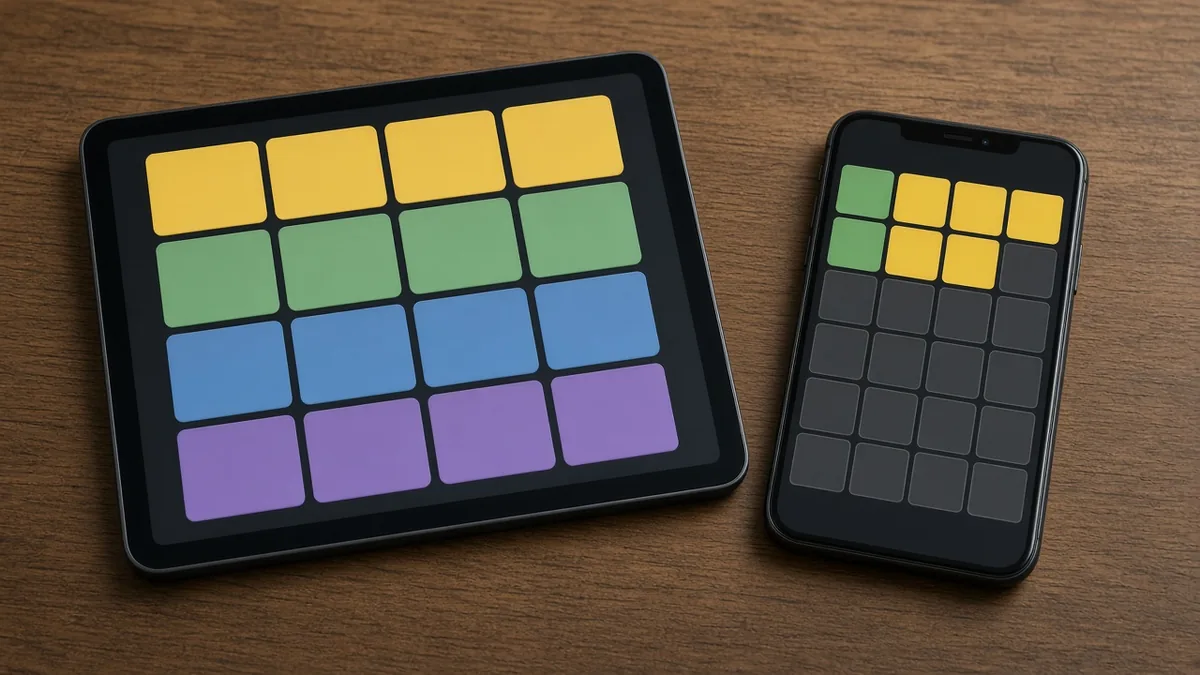
Connections vs Wordle is a comparison many daily puzzlers make, because both games come from The New York Times and both take a few minutes a day. They test different skills, though. Wordle asks you to find one hidden five-letter word in six guesses, using green, yellow and gray feedback. Connections gives you 16 words and asks you to sort them into four groups of four that share a hidden link, with only four mistakes allowed. Wordle rewards spelling and letter logic; Connections rewards vocabulary, lateral thinking and patience.
This site is an independent fan site and is not affiliated with The New York Times. We do not host Connections or publish its answers. This guide explains how the games differ and which Wordle habits help in Connections.
Quick comparison
| Wordle | Connections | |
|---|---|---|
| Goal | guess one hidden five-letter word | sort 16 words into four groups of four |
| Attempts | six guesses | four mistakes allowed |
| Feedback | green, yellow and gray tiles per letter | a group is confirmed only when all four words are right |
| Main skill | spelling patterns and letter elimination | word meanings, wordplay and categories |
| Difficulty colors | none | yellow, green, blue, purple |
| Time per day | usually 2–5 minutes | usually 5–10 minutes |
| Practice mode | unlimited games on independent sites | the daily puzzle |
Where each game came from
Wordle was created by Josh Wardle and released in October 2021. The New York Times bought it in January 2022, and it became the anchor of NYT Games. See Wikipedia's Wordle page.
Connections launched as a beta on June 12, 2023, edited by Wyna Liu. It quickly became one of the most-played NYT puzzles, partly because of the shared grid people post after solving. See Wikipedia's Connections page.
How Connections works
You see a 4x4 grid of words. Somewhere in it are four groups of four words that share something: a category, a phrase they complete, a sound or a hidden pattern. You select four words and submit. If all four belong together, the group locks in and its color appears. If not, you lose one of your four mistakes. Sometimes the game tells you that you are "one away", meaning three of your four are right.
Each group has a difficulty color:
- Yellow: the most straightforward group.
- Green: a little harder.
- Blue: harder still.
- Purple: the trickiest, often wordplay such as hidden words or words that go before or after a common term.
How Wordle works
You type a five-letter word. Each letter turns green if it is in the right spot, yellow if it is in the word but the wrong spot, and gray if it is not in the word. You have six tries. Every guess gives you information about letters, so the game is about using that information efficiently. Our best Wordle starting words and letter frequency guides cover the basics.
Is Connections harder than Wordle?
Many players find Connections harder, for three reasons:
- Red herrings. Connections deliberately includes words that seem to fit two groups. Wordle has no traps beyond tricky letter patterns, such as double letters.
- All-or-nothing feedback. Wordle tells you something about every letter. Connections only tells you whether a whole group is right, or that you are one away.
- Knowledge. Purple groups can depend on wordplay, slang or general knowledge, while Wordle needs only spelling.
That said, "harder" is personal. Strong spellers often find Wordle easy and Connections frustrating; people who love trivia often find the opposite.
Skills that carry over from Wordle
Wordle habits do help in Connections:
- Process of elimination. In Wordle you rule out letters; in Connections you rule out words. Solve the group you are surest about first, and the remaining words get easier.
- Patience before submitting. Hard-mode Wordle players learn not to waste guesses. In Connections, never submit a group until you have checked whether any word could belong elsewhere. Our Wordle hard mode guide trains the same discipline.
- Pattern spotting. Wordle teaches you to notice letter patterns. In Connections, look for words that share a prefix, a suffix, a hidden smaller word, or a sound.
- Hints before answers. In both games, a small nudge is more satisfying than a spoiler. See Wordle hints vs the answer.
Skills that are different
Some Connections skills have no Wordle equivalent:
- Thinking about meaning. Words can be nouns, verbs or names. "Bass" might be a fish or an instrument.
- Spotting fill-in-the-blank groups. Words such as "fire", "rain" and "snow" might all go before "ball" or after "camp".
- Finding the purple group last. Many players leave purple until the end, when the leftover four words make the link clearer.
A made-up example puzzle
Here is an invented Connections-style grid (not a real NYT puzzle) to show how the thinking works. Imagine these 16 words:
| BASS | SALMON | DRUM | PIANO |
| TROUT | FLUTE | PIKE | HARP |
| JACK | QUEEN | KING | ACE |
| SPRING | FALL | MARCH | MAY |
At first glance you might see a fish group (bass, salmon, trout, pike) and an instrument group (bass, drum, piano, flute, harp). Bass fits both, which is exactly the kind of red herring Connections uses. Playing cards look easy (jack, queen, king, ace), but "king" could also be a kind of salmon, and "jack" is a fish too.
The last row hides the trick: spring and fall are seasons, March and May are months, and all four are also everyday verbs (to spring, to fall, to march, you may). That is a purple-style group: the link is not the obvious category but a second meaning every word shares. Drum and jack can be verbs too, which is why purple groups need careful checking. Once you see it, the rest unlocks: instruments without bass (drum, piano, flute, harp), fish with bass (bass, salmon, trout, pike), and the cards.
The Wordle lesson here is elimination. Lock in the group with only one possible answer, and the overlaps fall away.
A simple Connections routine for Wordle players
- Read all 16 words slowly before touching anything.
- Note every possible group you can see, even if some overlap.
- Find words that could fit only one group and build from them.
- Submit the group you are most confident about first; it is often yellow.
- If you are "one away", swap the word you were least sure of.
- Leave the trickiest-looking words for last.
Building a daily puzzle habit
Many players do both games back to back. A common order is Wordle first, because it is quick, then Connections, which needs more thought. If you finish the daily Wordle and want more practice, play a few rounds of Wordle Unlimited, then come back to Connections with a fresh head. Our after-daily habits guide suggests a weekly routine.
Playing with friends and family
Both games are made for sharing. The Wordle grid shows how many guesses you took; the Connections grid shows the order you found the groups and any mistakes. Families often solve Connections together, because different people spot different categories: one person sees sports teams, another spots a hidden word. Wordle is usually a solo game, then compared afterwards.
Using the games with learners
Wordle is useful for spelling and phonics practice, because every guess must be a real word and the colors show which letters fit. Connections is useful for vocabulary and categories, because learners must explain why four words belong together. For younger players, Wordle is usually the easier starting point. Our free Wordle Unlimited game lets learners play as many rounds as they like without waiting for tomorrow.
Which should you play?
- Play Wordle if you want a quick, logical puzzle and you like spelling and letter strategy.
- Play Connections if you enjoy wordplay, trivia and puzzles with tricks.
- Play both if you want a balanced daily brain workout: logic first, then lateral thinking.
Common mistakes in each game
In Wordle, the most common mistakes are reusing gray letters, ignoring double letters and guessing the same pattern repeatedly when several words fit. Our solver is useful after a game to see which guess would have narrowed things faster.
In Connections, the most common mistakes are submitting the first four related words you see, forgetting that a word can belong to a different group than it first appears, and using up mistakes early on a guess you were unsure about. Slow down: you have no time limit, only a mistake limit.
Frequently asked questions
What is the difference between Connections and Wordle?
Wordle asks you to guess one five-letter word in six tries using letter feedback. Connections asks you to sort 16 words into four groups of four with only four mistakes allowed.
Is Connections harder than Wordle?
Many players find it harder because of red herrings and all-or-nothing feedback, but it depends on whether you are stronger at spelling or at wordplay and general knowledge.
What do the colors mean in Connections?
Each group has a color showing its difficulty: yellow is the most straightforward, then green, then blue, and purple is the trickiest.
How many mistakes can you make in Connections?
You can make four mistakes. After the fourth, the game ends and shows the answers.
Are Connections and Wordle made by the same company?
Both are published by The New York Times. Wordle was created by Josh Wardle and bought by the NYT in 2022; Connections was launched by the NYT in 2023. This site is independent and not affiliated with the NYT.
Can I play Connections on this site?
No. This site offers Wordle-style practice games and guides. To play Connections, use the official New York Times game.
Next: Open the Wordle solver · Today’s Wordle answer · All posts